For a niche ecommerce business, earning attention online can be harder than simply listing products and waiting for customers to arrive. Online store backlinks—links from relevant websites to your own—can help shoppers discover a store and give search engines useful context about its expertise. The strongest approach is not to collect as many links as possible, but to create credible reasons for other sites to mention your business.
Why backlinks matter to ecommerce sites
A link can bring a reader directly to a useful page, such as a buying guide, product category or explanation of how an item is made. It may also contribute to a search engine’s understanding of a site’s reputation and subject matter. But a backlink is not a guarantee of higher rankings or sales. Its value depends on where it appears, whether it makes sense in context, and whether the linked page genuinely helps the visitor.
This is especially important for stores in specialized or regulated markets. Products such as hemp-derived goods may be subject to changing laws, age restrictions, advertising rules and platform policies. A link-building plan should prioritize accurate information and responsible outreach rather than trying to bypass restrictions or make unsupported product claims.
Build pages worth citing
Before contacting publishers, review the pages you want them to link to. A category page can be useful when it clearly explains what the category includes, how products differ and what customers should check before buying. Product pages should provide precise descriptions, transparent policies and relevant details instead of vague promises.
Consider adding supporting resources that answer common questions. Depending on the business and applicable rules, these might include a glossary, a guide to reading product labels, storage information, or an overview of how to check local regulations. Keep health and safety content careful and evidence-based; avoid presenting a product as a treatment or making claims that the available evidence does not support.
Good resources give writers, community sites and industry publications something specific to reference. They also give visitors a reason to stay on the site and explore. If an article explains a topic clearly, it may attract links over time without every mention having to come from direct outreach.
Find relevant places to earn links
Relevance matters more than a website’s general popularity. Look for publishers and organizations whose readers have a genuine interest in ecommerce, small-business operations, product education or the wider category your store serves. A link in a relevant, informative article is usually more useful to readers than one placed on an unrelated page built only to host links.
- Offer expert input: Share useful, verifiable information with journalists or editors who cover your market.
- Contribute a practical article: Suggest a focused topic that fits a publication’s audience, rather than sending a generic pitch.
- Correct outdated resources: If a guide contains obsolete information, politely offer an accurate update and a suitable source.
- Build local connections: Where relevant, participate in community events, business groups or educational projects that may naturally mention your site.
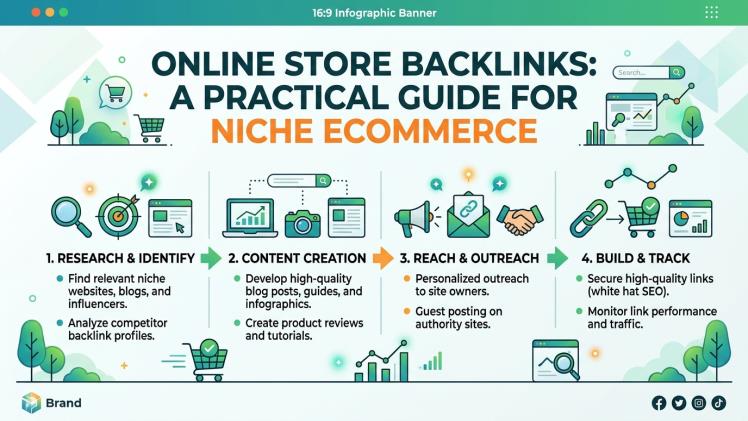
Outreach should be personal and specific. Explain why the proposed resource fits the page and what a reader gains from it. Avoid buying links that promise rankings, sending mass messages, or using keyword-heavy anchor text in every placement. Such tactics can create low-quality links and undermine trust.
Link to product and category pages thoughtfully
Many ecommerce sites focus all link-building effort on the homepage. That can leave useful category and product pages difficult to discover. A balanced plan gives publishers a relevant destination: a category page for a broad overview, a product page for a specific item, or an educational guide for a question that needs a fuller answer. The page should match the context of the mention, not simply be the page the store most wants to promote.
For a closer look at approaches for earning online store backlinks to product and category pages, consider how the proposed link serves both the publisher and the shopper. Use descriptive anchor text naturally, and make sure the destination works well on mobile and provides the information promised in the surrounding article.
Measure quality, not just volume
Keep a simple record of outreach, placements, destination pages and referral visits. Review whether links bring relevant visitors, whether the linked pages answer their questions, and whether the relationship leads to useful mentions elsewhere. Search performance can take time to change, so avoid judging a campaign by a short-term ranking fluctuation alone.
It can also help to set a realistic budget for research, writing and outreach. Freelancers may support different parts of the process, from content planning to public relations. Before hiring, agree on deliverables, timelines and how success will be assessed; understanding freelance marketing project pricing can make those conversations clearer. Osdire, for example, is a marketplace where buyers can hire freelancers across marketing and other categories, with project terms established through the platform.
Make credibility the foundation
Effective link building is an extension of useful publishing and genuine relationships. Create accurate pages, approach relevant publishers with a clear reason to care, and follow the rules that apply to your products and audience. A smaller number of well-placed, editorially appropriate links can do more for discovery and customer confidence than a large collection of unrelated placements. Keep improving the underlying site, and let links point to pages that deserve a reader’s attention.